It has been many years since we held our first Nonprofit Board Connect event.
Not everyone understood the idea initially. Why create an event specifically to connect talented, diverse leaders with nonprofit boards? The answer was and remains, fairly simple: strong regions need strong institutions, and strong institutions need boards that reflect the breadth of talent, experience and perspective within the communities they serve.
Too often, the same visible people are asked to serve repeatedly, not because there is a shortage of capable people, but because institutions continue looking within the same familiar networks.
The data reinforce the point. BoardSource found that 78% of nonprofit board members were white, 19% of participating organizations had all-white boards and 62% of nonprofit chief executives surveyed said their boards did not reflect the communities they served.
This year’s Nonprofit Board Connect event is the largest in its history. We are oversubscribed. That tells me more people understand that board diversity is not about filling seats or checking boxes. It is about strengthening governance, widening perspective and connecting institutions to the communities they serve.
This work continues something I cared deeply about in my former role and still believe is essential to the success of any region: preparing great people, all kinds of people, to help lead its institutions, while being intentional about increasing the presence of Black and brown leaders in rooms where consequential decisions are made.
I have long believed that part of the problem is that many white people do not see themselves as part of diversity. They see diversity as everyone else. But a truly diverse society includes all of us, Black, white and people of every background. The goal is not to suggest that being white is somehow bad or to replace one group with another. It is to stop treating any one group as the default while everyone else is labeled “diverse.”
That broader understanding does not eliminate the need for intentionality. Black and brown people remain underrepresented on many boards, and changing that requires deliberate action. The goal is to build governing bodies that draw upon the full range of people, experiences and perspectives within the communities they serve.
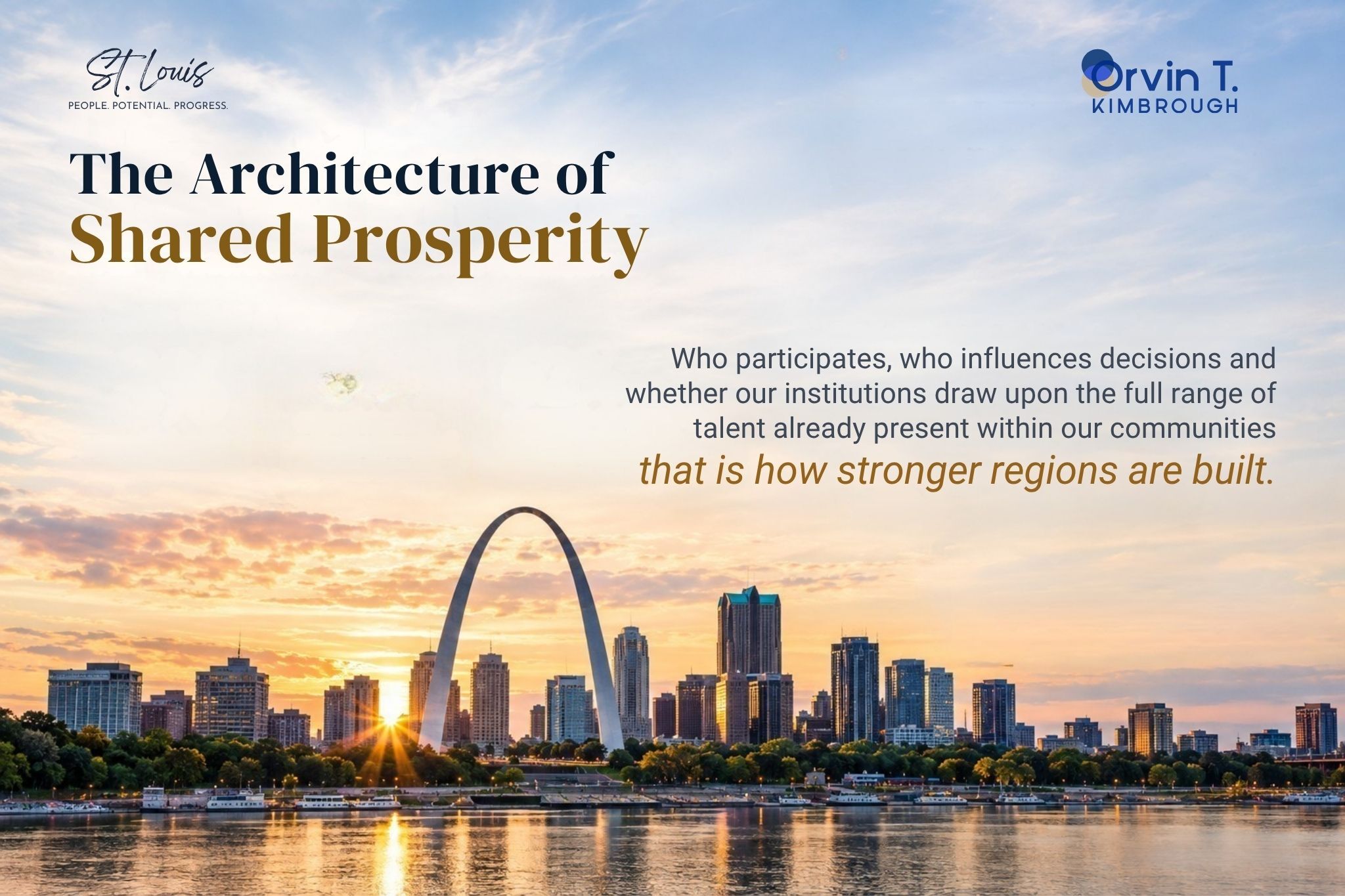
At this year’s event, I will also release my newest mission brief, The Architecture of Shared Prosperity. It builds on papers I released in 2019 and 2020.
This is not an academic paper. I wrote it to be accessible to Main Street while challenging those of us in positions of influence to think more deeply about how a region creates shared economic prosperity.
The paper reflects what I have learned during nearly eight years in my current role. I have tried to hold two truths together: we should challenge people to rise, exercise agency and do what is within their control; and we must be honest about the structural barriers that can constrain even their best efforts. Shared prosperity requires both personal responsibility and institutional responsibility.
Dignified work, entrepreneurship, ownership, education, health and neighborhood stability are connected. Each becomes more achievable when more people can participate meaningfully in the economy.
Not everyone will agree with everything I have written. That is okay. My purpose is to put forward a vision for St. Louis and perhaps other metropolitan regions—that gives us something concrete to examine, debate and improve.
Board service and shared prosperity may appear to be separate subjects. I believe they are part of the same architecture: **who participates, who influences decisions and whether the institutions shaping a region draw upon the full range of talent already present within it.**
That is how stronger institutions and stronger regions are built.



 Thought-provoking reflections and leadership perspectives